
Sweepstakes Casino Legal States: 2026 US Availability
 Available in GB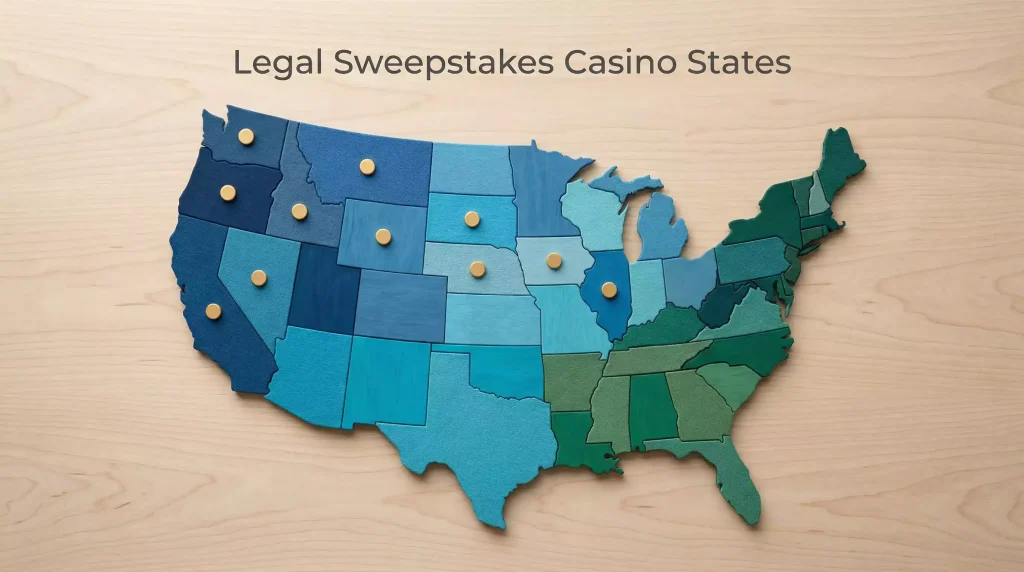
Sweepstakes casino legal states number more than 35 across the country, offering access to casino-style gaming in jurisdictions where traditional iGaming remains off-limits. This legal availability creates both opportunity and confusion—players often struggle to determine whether they can legally participate, and the answer can change faster than most people expect.
The contrast with regulated online gambling illustrates the scope of this availability gap. While licensed iGaming operates in just seven states, sweepstakes casinos have established legal footing across most of the nation. Texas, Florida, Ohio, Georgia—states where real-money online casinos cannot operate—all permit sweepstakes casino participation under current interpretations. That’s hundreds of millions of potential players who have few other options for online casino-style entertainment.
Yet the phrase “legal in your state” carries significant caveats. Washington has explicitly classified sweepstakes casino gaming as illegal gambling. Idaho, Nevada, and Michigan have implemented various restrictions. New York’s attorney general forced 26 platforms to exit the state in 2026. California’s prohibition took effect January 1, 2026. The regulatory landscape shifts beneath this industry’s feet with uncomfortable regularity, making static “legal states” lists unreliable within months of publication.
This guide provides the state-by-state breakdown you need to understand where sweepstakes casinos currently operate, which states restrict or prohibit them, and what pending legislation could reshape the map. We’re not lawyers and this isn’t legal advice—but it’s the clearest picture available of sweepstakes casino geography as it exists right now in 2026.
US State-by-State Sweepstakes Accessibility Map
The sweepstakes casino landscape divides into three categories: states with unrestricted access, states with explicit prohibitions, and states with partial restrictions or pending legislation. Understanding which category your state falls into determines whether you can legally participate—and whether that status might change soon.
Green represents full availability: sweepstakes casinos operate without significant legal challenges, accepting registrations and processing redemptions for residents. This includes the majority of states—places like Texas, Florida, Ohio, Pennsylvania, Georgia, and Illinois. These states haven’t enacted specific prohibitions against sweepstakes casino platforms, allowing operators to function under general promotional sweepstakes frameworks.
Red indicates prohibition or severe restrictions. Washington State leads this category with explicit felony-level classifications of sweepstakes casino gaming as illegal gambling. Idaho has implemented regulatory restrictions. Nevada prohibits sweepstakes casinos to protect its licensed gaming industry. California’s ban took effect at the start of 2026. Michigan restricts access to protect its licensed iGaming market. These states have taken definitive action against the sweepstakes casino model.
Yellow marks states in transition—jurisdictions where enforcement actions have occurred, legislation is pending, or regulatory interpretation remains uncertain. New York and New Jersey fall into this category following significant legislative and enforcement developments in late 2026. Tennessee’s attorney general has taken aggressive action against operators. These states require particular attention because their status could shift with minimal warning.
States Where Sweepstakes Casinos Operate Freely
The list of states permitting sweepstakes casino operation spans most of the country, encompassing every region and population density. These jurisdictions haven’t specifically prohibited sweepstakes-based gaming platforms, allowing operators to accept players under standard promotional sweepstakes law.
Northeast Region
Connecticut, Maine, Massachusetts, New Hampshire, Rhode Island, and Vermont all permit sweepstakes casino participation. The irony isn’t lost on industry observers: Connecticut and Rhode Island have legalized traditional iGaming, meaning residents can choose between licensed casinos and sweepstakes platforms. Pennsylvania follows the same pattern—robust licensed iGaming market alongside unrestricted sweepstakes casino access.
Delaware and Maryland represent available markets with different traditional gambling profiles. Delaware pioneered legal iGaming but hasn’t restricted sweepstakes alternatives. Maryland has legal sports betting without iGaming, making sweepstakes casinos the only online casino option for residents seeking that experience.
Southeast Region
Florida stands as one of the largest sweepstakes casino markets by population, with nearly 23 million potential players. The Sunshine State lacks legal iGaming but permits sweepstakes platforms, driving significant player activity at major operators. Georgia follows a similar profile—large population, no legal iGaming, active sweepstakes casino participation.
North Carolina, South Carolina, Virginia, and West Virginia all permit sweepstakes casino access. Virginia represents an interesting case: legal sports betting exists, iGaming bills continue circulating, but sweepstakes casinos operate without restriction in the interim. Kentucky and Alabama round out the region’s available markets, though Kentucky’s history of aggressive enforcement against specific operators suggests scrutiny remains possible.
Midwest Region
Ohio represents the prototypical sweepstakes casino market—a state that has embraced sports betting and may eventually legalize iGaming, but currently offers sweepstakes platforms as the sole online casino option. With nearly 12 million residents, it’s a significant market for operators seeking customers in non-iGaming states.
Illinois, Indiana, Wisconsin, Minnesota, Iowa, and Missouri all permit sweepstakes casino participation. These states collectively represent tens of millions of potential players with limited legal alternatives for casino-style online gaming. Nebraska, Kansas, North Dakota, and South Dakota complete the regional picture, generally permitting sweepstakes operations under promotional frameworks.
Southwest and Mountain West
Texas dominates this region as the largest available market nationwide. With nearly 30 million residents and no legal pathway to traditional iGaming on the horizon, Texas represents a crown jewel for sweepstakes casino operators. The state’s Business Code Title 13 provides the legal framework under which promotional sweepstakes operate.
Arizona, New Mexico, Oklahoma, and Colorado all permit sweepstakes casino access. Arizona and Colorado have legal sports betting; none have iGaming. Arkansas, Louisiana, and Mississippi round out the region. Utah presents a unique case—one of the most restrictive gambling states nationally—but sweepstakes casinos have nonetheless operated there under promotional frameworks, though with particular caution given the state’s general anti-gambling stance.
Pacific Region
Oregon, Alaska, and Hawaii permit sweepstakes casino participation, though Hawaii’s general opposition to gambling expansion creates an uncertain climate. The region’s restrictions center on California and Washington—both enormous markets now off-limits to operators—alongside Nevada’s protective stance toward its licensed gaming industry.
The availability across these states reflects a common pattern: most jurisdictions haven’t specifically legislated against sweepstakes casinos, and operators have interpreted this silence as permission to operate. Whether that interpretation survives future regulatory scrutiny varies by state, but for now, residents of these available states can participate at major platforms without immediate legal concern.
Restricted and Prohibited States
A handful of states have taken definitive action against sweepstakes casinos, either through explicit legislation, attorney general enforcement, or regulatory interpretation. Players in these jurisdictions face potential legal consequences for participation, and operators either block access entirely or operate at significant legal risk.
Washington State: The Clearest Prohibition
Washington State classifies sweepstakes casino gaming as illegal gambling under state law, potentially at the felony level. The state’s gambling statutes are among the nation’s strictest, and sweepstakes casino operators have consistently either blocked Washington residents or explicitly warned them against participation. For Washington players, no major sweepstakes casino currently accepts registrations, making this the most definitive restriction in the country.
The Washington precedent set the template for future enforcement. When the Double Down Interactive class-action settlement reached $415 million—based on claims that the platform’s social casino constituted illegal gambling under Washington law—operators across the industry took notice. The stakes of operating in prohibition states became unmistakably clear.
Idaho: Conservative Stance
Idaho takes a conservative position on gambling generally, and sweepstakes casinos have largely avoided operating there. The state attorney general’s interpretations suggest sweepstakes casino gaming may violate state gambling prohibitions, even if no explicit legislation exists. Major operators block Idaho registrations or require players to acknowledge they’re not Idaho residents.
Michigan: Protecting Licensed iGaming
Michigan represents a different motivation for restriction—protecting its licensed iGaming market from sweepstakes competition. The state legalized online gambling in 2019, and regulators have signaled that sweepstakes casinos competing with licensed operators create unfair competition. Most major platforms now block Michigan access, though some smaller operators have historically accepted Michigan players at their own risk.
Nevada: Protecting Las Vegas
Nevada’s prohibition stems from straightforward market protection. The state’s entire economy revolves around licensed gambling, and regulators have no interest in permitting unlicensed alternatives to compete. Sweepstakes casinos don’t operate in Nevada, and they’re unlikely to test that prohibition given the state’s regulatory resources and gambling expertise.
New York: Recent Crackdown
New York’s situation evolved rapidly in 2026. The state attorney general sent cease-and-desist letters to 26 online sweepstakes platforms, all of which complied. This enforcement action effectively shut down sweepstakes casino access for New York residents without waiting for legislative changes. The attorney general’s position: these platforms constitute illegal gambling that harms consumers and evades regulatory oversight.
New Jersey: iGaming Competition
New Jersey followed a similar path to Michigan, prioritizing its established licensed iGaming market over sweepstakes competition. The state’s Division of Gaming Enforcement has taken positions suggesting sweepstakes casinos may violate state gambling laws, and pending legislation would impose substantial civil penalties on operators. Most platforms now restrict New Jersey access.
California: New Prohibition Effective 2026
California’s sweepstakes casino ban took effect January 1, 2026, making the nation’s most populous state off-limits to operators. The prohibition emerged from a combination of tribal gaming interests and regulatory concerns about unregulated gambling. With nearly 40 million residents now excluded, operators lost access to what could have been their single largest market.
Tennessee: Aggressive Enforcement
Tennessee’s attorney general sent cease-and-desist letters to nearly 40 sweepstakes casino operators in December 2026, asserting they violated state gambling laws. Attorney General Jonathan Skrmetti stated bluntly that these platforms work hard to appear legitimate but fundamentally are not. While legal challenges could follow, operators have largely complied by blocking Tennessee access pending resolution.
Pending Legislation and Regulatory Changes
The legislative environment for sweepstakes casinos shifted dramatically in 2026, with multiple states introducing bills specifically targeting these platforms. Understanding pending legislation helps players anticipate which available states might soon join the restricted list—and how severely operators could be penalized.
New York S5935A: Signed Into Law
New York’s sweepstakes casino legislation moved from pending to enacted when Governor Hochul signed S5935A into law as Chapter 605 in December 2026. The law establishes penalties of $10,000 to $100,000 per violation for operators running unlicensed casino-style games in the state. Combined with the attorney general’s enforcement actions, this legislation cements New York’s status as off-limits for sweepstakes casinos for the foreseeable future.
State Senator Joseph P. Addabbo Jr., who chairs the Racing, Gaming, and Wagering Committee, articulated the legislative position directly: if a game looks like a casino game, acts like a casino game, and pays out real money like a casino game, then it’s a gambling game that shouldn’t operate in New York without proper regulation. This definitional approach could influence other states considering similar measures.
New Jersey AB 5447: Signed Into Law
New Jersey’s sweepstakes casino legislation became law when Governor Murphy signed Assembly Bill 5447 on August 15, 2026. The law establishes civil penalties of $100,000 for first offenses and $250,000 for subsequent violations. The legislation targets unlicensed internet gaming operations, explicitly including sweepstakes-style platforms that the state views as circumventing its licensed iGaming framework.
AB 5447 creates one of the nation’s most punitive environments for sweepstakes operators. The financial penalties alone make New Jersey operation economically irrational even for operators willing to test legal boundaries. Most platforms have already withdrawn from New Jersey in response, cementing the state’s status as off-limits for sweepstakes casinos.
Timeline and Uncertainty
Legislative timelines remain unpredictable. Bills introduced in one session may die in committee, pass quickly, or carry over to future sessions with amendments. Players in states with pending legislation should monitor developments closely—the transition from “legal” to “prohibited” can happen within a single legislative session.
Several additional states have seen sweepstakes casino bills introduced without yet reaching votes: variations on licensing requirements, consumer protection mandates, and outright prohibitions. The common thread is increasing legislative attention to an industry that operated largely unnoticed until its scale became impossible to ignore.
What If Your State Changes Status
Players should understand what happens when a state transitions from available to restricted. Typically, operators block new registrations immediately upon enforcement action or legislation taking effect. Existing accounts present more complexity—some operators freeze accounts and require players to withdraw remaining balances, while others continue limited operations pending final resolution.
The player experience of state-level restriction usually isn’t catastrophic. Operators generally don’t confiscate player funds when exiting a state; they process remaining redemptions and then prevent future deposits or play. The more significant impact is losing access to the entertainment option entirely, which may be permanent depending on how the legal situation resolves.
Recent Enforcement Actions
Enforcement activity against sweepstakes casinos accelerated dramatically in late 2026, signaling that state attorneys general view these platforms as priorities worth pursuing. Understanding these actions helps players gauge regulatory risk and operator vulnerability in their own states.
New York Attorney General Actions
New York Attorney General Letitia James announced in 2026 that her office had sent cease-and-desist letters to 26 online sweepstakes platforms operating in the state. All 26 complied, effectively ending sweepstakes casino access for New York residents in a matter of weeks. The enforcement rationale centered on consumer protection: “Online sweepstakes casinos are not subject to audits and other regulatory oversight by the state to ensure that games are not rigged, putting New Yorkers at risk,” James stated in the enforcement announcement.
This action demonstrated that attorney general enforcement can reshape the market faster than legislation. Rather than waiting years for bills to pass, James used existing legal authority to assert that sweepstakes casinos constitute illegal gambling under current New York law. Operators, facing potential prosecution and civil liability, chose compliance over confrontation.
Tennessee Attorney General Actions
Tennessee’s attorney general took similar action in December 2026, sending cease-and-desist letters to nearly 40 sweepstakes casino operators. Attorney General Jonathan Skrmetti’s public statement was particularly blunt about the industry’s legitimacy: these platforms work hard to appear legitimate, but they’re fundamentally designed to take players’ money without the consumer protections that regulated gambling provides.
Tennessee’s enforcement is notable because the state lacks legal iGaming—there’s no licensed market that sweepstakes casinos compete against. The enforcement rationale focused purely on gambling law violations and consumer protection, suggesting that states without iGaming interests can still take aggressive action against the industry.
Settlements and Civil Actions
Beyond attorney general enforcement, class-action litigation has produced significant settlements that shape operator behavior. VGW Holdings, operator of LuckyLand Slots and Chumba Casino, settled with Kentucky for $11 million in 2022 and agreed to exit the state entirely. This settlement established a template: states willing to pursue civil enforcement can extract substantial payments and force market exits.
The Double Down Interactive settlement—$415 million to resolve Washington State claims—remains the largest judgment against a social/sweepstakes gaming platform. Though Double Down operated differently from modern sweepstakes casinos, the precedent influences how operators assess state-level risk. Washington’s aggressive interpretation of gambling law cost one company more than most sweepstakes casinos generate in years.
What Happens to Players
When enforcement actions target operators, players generally face minimal direct consequences. State attorneys general focus on the companies, not individual users. Typical enforcement results in operators blocking access for residents of the enforcing state, processing pending redemptions, and closing accounts—inconvenient, but not legally threatening for players.
That said, players shouldn’t assume complete immunity. Washington State’s gambling laws theoretically apply to players as well as operators, even if enforcement against individuals is rare. Players in restricted states who find workarounds to access blocked platforms take on additional risk that most people aren’t equipped to evaluate. When an operator blocks your state, the prudent response is to cash out and move on rather than attempting circumvention.
State-Specific Legal Considerations
Beyond the binary available/restricted classification, certain states present unique legal contexts that players should understand. These jurisdictions don’t prohibit sweepstakes casinos but operate under frameworks that could shape future enforcement or create specific player obligations.
Texas: The Largest Market
Texas represents sweepstakes casinos’ most significant market—nearly 30 million residents with no legal iGaming alternative. The state’s Business Code Title 13 provides the promotional framework under which sweepstakes operate. Texan players should understand that while sweepstakes casinos currently function without state interference, Texas gambling law is conservative, and future legislative attention remains possible.
The absence of Texas enforcement to date doesn’t guarantee permanent acceptance. As the industry’s profile rises nationally, Texas legislators may face pressure to address sweepstakes casinos directly. For now, though, Texas remains firmly in the “available” category, and major operators prioritize the market accordingly.
Florida: Tribal Gaming Complexity
Florida’s gambling landscape involves complex relationships between state government, the Seminole Tribe, and various gaming interests. The 2021 gaming compact theoretically gave the Seminole Tribe extensive control over online gambling in the state, though implementation has been legally contested. Sweepstakes casinos have operated through this uncertainty, but Florida’s eventual resolution of its gaming framework could affect sweepstakes availability.
Florida law (Section 849.094) creates exceptions for promotional games and sweepstakes, which operators cite as the basis for their presence. Whether those exceptions survive future legal scrutiny depends on how courts and regulators interpret the promotional model. For now, Florida players can participate, but the state’s gaming politics create underlying uncertainty that doesn’t exist in less contested markets.
Ohio: Growing Market Post-Sports Betting
Ohio legalized sports betting in 2023, creating a regulated online gambling presence in the state. iGaming hasn’t followed, meaning sweepstakes casinos remain Ohio residents’ sole option for online casino-style play. The state’s willingness to embrace sports betting suggests potential iGaming legalization eventually, which could then trigger Michigan-style restrictions on sweepstakes competition.
Ohio players currently enjoy unrestricted access to sweepstakes platforms, but should monitor the state’s iGaming discussions. If Ohio licenses online casinos, sweepstakes operators may face the same pressure to exit that occurred in Michigan—protecting licensed operators from unlicensed competition.
Pennsylvania: Parallel Markets
Pennsylvania offers both licensed iGaming and unrestricted sweepstakes casino access, creating a unique market where players can choose between regulated and unregulated options. This coexistence is unusual—most iGaming states have restricted sweepstakes competition—and may not last indefinitely. Pennsylvania gaming regulators could eventually decide that sweepstakes casinos undermine the licensed market.
For now, Pennsylvania players benefit from maximum choice: licensed casinos with guaranteed consumer protections alongside sweepstakes platforms with their own bonus structures and game selections. This parallel market demonstrates that coexistence is possible, even if other states have chosen restriction instead.
The Future of Sweepstakes Casino Legality
Predicting regulatory futures is inherently speculative, but current trends suggest sweepstakes casinos face an increasingly constrained legal environment rather than expanding acceptance. Understanding these trends helps players assess how long their current access might last.
More Regulation or More Prohibition?
The industry faces a strategic choice that states are forcing: accept regulation or face prohibition. Some industry voices advocate for a licensing framework that would provide consumer protections while allowing continued operations—essentially transforming sweepstakes casinos into a regulated product category. Others see any regulatory framework as existentially threatening to the current business model.
States with licensed iGaming will likely continue restricting sweepstakes competition. The economic logic is straightforward: licensed operators pay taxes and fees, sweepstakes operators don’t. States that have invested in building legal iGaming markets have strong incentives to protect those investments from unlicensed competition.
Federal-Level Possibilities
Federal legislation specifically addressing sweepstakes casinos remains unlikely in the near term. Congress has shown little appetite for gambling legislation generally, preferring to leave the issue to states. The American Gaming Association has advocated for federal action against illegal offshore gambling—and explicitly includes sweepstakes casinos in that category—but congressional response has been minimal.
Should federal legislation emerge, it would likely take one of two forms: explicit prohibition of sweepstakes casino models nationwide, or a federal licensing framework that preempts state-by-state regulation. Neither outcome seems imminent, but players should recognize that federal action could override any state’s current permissive stance.
Industry Trade Group Positions
The American Gaming Association, which represents licensed casino operators, has consistently criticized sweepstakes casinos as illegal gambling that evades taxation and consumer protection requirements. AGA estimates suggest unregulated gaming operators cost states $17.3 billion annually in lost tax revenue—a figure that includes sweepstakes casinos alongside offshore sportsbooks and other unlicensed platforms.
This industry opposition matters because licensed casino operators have significant political influence in state capitals. When the AGA and its members lobby against sweepstakes casinos, legislators listen. The organized opposition from established gambling interests creates ongoing pressure that smaller sweepstakes operators struggle to match.
Recommendations for Players
Players should adopt a realistic attitude toward sweepstakes casino access: it’s available now in most states, but permanence isn’t guaranteed. Practical steps include staying informed about your state’s regulatory developments, maintaining awareness that accessible platforms today could become blocked platforms tomorrow, and avoiding building entertainment routines around access that may disappear.
If your state is currently considering legislation or has seen recent enforcement activity, operate under the assumption that restrictions are coming. Enjoy the access while it lasts, but don’t be caught off-guard when the legal landscape shifts. The sweepstakes casino industry has grown rapidly, but rapid growth doesn’t confer legal immunity—as operators in New York, Tennessee, and California have learned firsthand.